

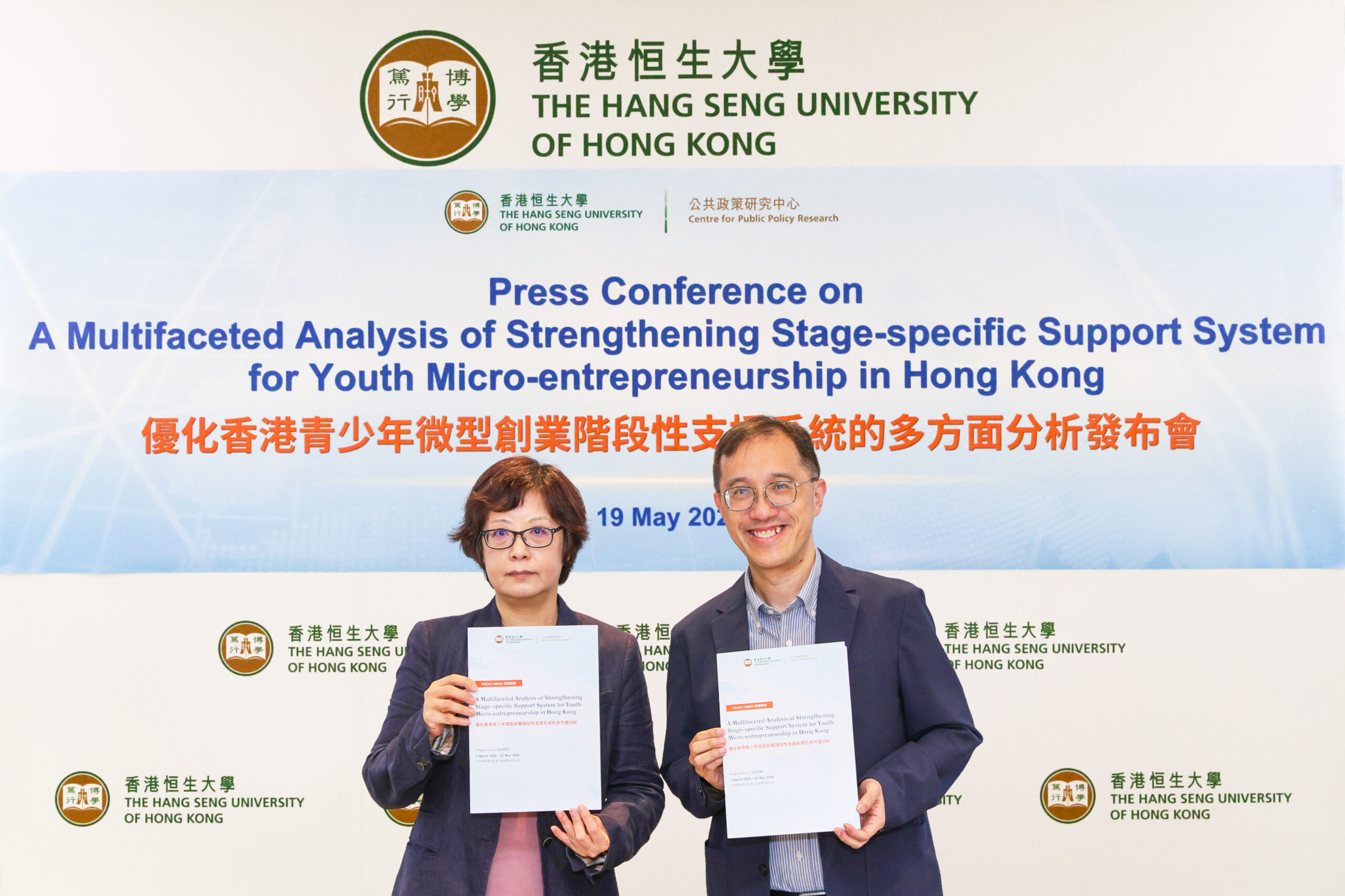
A study by a research team at HSUHK led by Dr Victor Chan, Assistant Professor in the Department of Social Science and Dr Eva Hung, Acting Director of the School of Transdisciplinary Studies, has identified significant gaps in support for young micro-entrepreneurs in Hong Kong, particularly those in non-technology sectors. The findings suggest that entrepreneurship support should better reflect the different needs young people face as their businesses develop.
Funded by the Public Policy Research Funding Scheme of the HKSAR Government, the study “A Multifaceted Analysis of Strengthening Stage-Specific Support System for Youth Micro-Entrepreneurship in Hong Kong” draws on policy analysis, interviews with 25 youth micro- entrepreneurs and 20 support providers, and a survey of 627 youth micro-entrepreneurs.
Funding emerged as a challenge throughout the entrepreneurial journey. Nearly 70% of respondents at the earliest stage identified insufficient funding as their main challenge. The figure remained at 54.1% among those at the survival or success stage and 45% among those at the take-off or maturity stage.
The study also found a notable support gap for non-technology businesses. Respondents considered many existing programmes to be geared towards artificial intelligence, deep technology and highly scalable startups, while businesses in retail, food and beverage, creative industries and professional services received less attention. Fewer than one in 10 respondents felt that existing support was sufficient. More than 80% hoped for more accessible funding, while simpler application procedures, marketing support and mentoring were also widely sought.
Informal networks continue to play an important role. More than 46% of respondents relied mainly on support from family, friends, peers and partners, compared with 18.2% who primarily used formal support channels. Nearly 95% used personal savings as startup capital, and 62.7% received financial support from family members.
The research also examined young entrepreneurs’ interest in the Greater Bay Area (GBA). Despite recognising its larger market and business opportunities, only 11.3% had expanded into the GBA or planned to do so. Major barriers included costs, limited market knowledge, regulatory differences and a lack of local networks.
The findings also show that young entrepreneurs define success in different ways. While 39% prioritised business expansion, others placed greater importance on stable income, work-life balance and social impact.
Dr Victor Chan said, “Youth micro-entrepreneurs promote innovation, create employment opportunities, and enhance young people’s self-reliance and social mobility.” He added that the research team recommends a more inclusive and stage-specific support system, including more accessible funding, stronger mentoring networks, dedicated support for non-technology businesses, enhanced entrepreneurship education and practical support for expansion into the GBA.
The study highlights the importance of recognising different pathways to entrepreneurship and creating an environment in which young people can build resilient and sustainable businesses.